Friday, 22 August 2014

An Introduction to Shintoism and Shrines in Japan

In this post, I'd like to introduce the indigenous Shinto religion in Japan and explore it's basic beliefs and significant structures.

A large Buddha at a temple in Nagasaki.
I must begin by saying that the Japanese Shinto religion has been gradually influenced since 552 (or 558) by Chinese Buddhism. Chinese Buddhism worships "the Enlightened One", Guatama Siddhartha, who first taught the religion around the 5th or 6th Ce. B.C. in today's Nepal and India. Basic tenements of the religion are a belief in the constantly changing nature of the universe and ourselves, having compassion for all sentient beings, and trying to attain self-control of our lust and anger.

Look closely to see the torii in the distance.
On a rainy day at Miyazaki Jingu.
I find shrines to be beautiful, natural, peaceful places.
Japanese Shintoism is more a perspective and outlook to guide a way of being rather than a strict doctrine. It does not have a founder, written text, or exact set of ethical rules to follow. However, it is still very much a religion because it is an ancient and traditional set of beliefs that promotes divine beings, offers sacred places and rituals of worship, and explores ideas about the relationships within the universe.

Lots of well manicured greenery
at shrines, revering nature.
The word Shinto means "way of the Gods", and so Shintoism believes in the existence of various forms and levels of divine beings found throughout the universe (神 - Kami). There are generally three categories of these Kami; those associated with nature (the essence of natural rock formations or bodies of water, for example), family ancestors (especially revered by those of noble lineage), and the souls of the auspicious dead (mostly soldiers or war heros who are respected for their bravery and service).

A small offering area
with a shimenawa rope.
According to belief, the two original Kami, and creator beings, were Izanagi and his partner Izanami. Their daughter is Amaterasu, the Sun Goddess, who is fittingly the most famous and prominent of the divine beings in the Land of the Rising Sun. Amaterasu is believed to be the divine ancestor of the Emperor of Japan and his lineage. While I don't believe in the mythologies associated with the religion, I still enjoy learning about them and find them interesting and beautiful, especially in terms of their uniqueness and long histories.
Torii and shimenawa in Nagasaki

Most of Japan's famous matsuri (祭り - festivals) are based on Shintoism, and usually offer a way of communication to the Gods in a specific season or to mark a certain life event. (If you continue to follow my blog, I plan to do a brief introduction of all the festivals throughout the year as I experience them). 

Typical ikebana arrangement.
Japan's traditional arts are also linked to Shintoism and adhere to its ideals, for example tea ceremony and ikebana (生け花 - traditional flower arrangement). I have been participating in my school's ikebana club for about a year now, and while the instruction and explanation of the significance is in Japanese and much of it goes over my head, I have definitely (by some kind of osmosis) come to understand some of the basic principles. I'll probably do a separate blog posting about my ikebana club at another time, but here's a photo for now ;)

The most famous (floating) torii at
Itsukushima Shrine, Miyajima
Shrines are dedicated to one of these divine beings and are specifically placed in a setting of seeming divine quality because of it's natural beauty. One of the main aspects of Shinto that I love is the respect for nature. Other important ideals of the religion, and which I also truly appreciate, are sincerity (真 - "makoto"; the main guiding force for Shinto ethics), harmony, balance, and an appreciation of aesthetic qualities. And even though there isn't a strict set of rules to abide by, Shintoism believes that these principles will guide people to lead a moral life.

Koma-inu at
Aoshima Jinja, Miyazaki.
When approaching a Shinto shrine (called a "jingu" 神宮 or "jinja" 神社) in Japan, the first thing you will always see is a large (usually) red structure, called the torii gate (鳥居). This gate marks the entrance to the sacred place.

Koma-inu at a Chinese temple in Nagasaki.
Next you will see two koma-inu (狛犬 - lion/dog/fox stone statues) which can be traced to Chinese, Korean, and even Hindu influence. They are known to be guardians who ward off evil spirits. One of these has its mouth open and the other closed, representing the "A" and "M" sounds respectively, which are seen as the first and last sounds and thereby represent the beginning and end of all things.

As you are now approaching closer to the main shrine, it is necessary for you to purify yourself. This is done with water and you will find a chozuya or temizuya (water purification pavilion) with a water dragon guardian and some ladles.

To do the purification properly follow these steps:

Water purification area
at Aoshima Jinja, Miyazaki.
1) Take the ladle in your right hand and pour water over your left hand, being careful not to let the dirty water back into the main water basin.
2) Switch hands and repeat for the right hand.
3) Swap the ladle again back to your right hand and pour some water into your left palm.
4) Take a sip of the water from your left hand to purify your mouth.
5) Wash your left hand again.
6) Pour any remaining water down the handle of the ladle to rinse the area you touched.
7) Place the ladle back face down as you found it.

When you approach the main alter, to make an offering and prayer, follow these steps;

The main offering space at a
beautiful shrine in Kumamoto.
1) Bow deeply twice.
2) Offer a coin into the saisen-bako (collection box) with a gentle toss. The luckier ones to offer are those with a hole in the center; the ¥5 and ¥50 coins.
3) Clap your hands twice (to signal to the gods that you wish your prayer to be heard).
* Sometimes you may also find a suzu (鈴 - long rope with a large bell) to make yourself heard by the Gods.
4) Silently pray.
5) Bow once more deeply to show gratitude.

An example of shimenawa rope and paper.
This is at Udo Jingu, a cave shrine in Nichinan.
Around the shrine area there are a number of other things that you should notice. One is the shimenawa (注連縄 - a large rope with white folded paper hanging from it). This marks the border of the secular area and the sacred place and can even be hung around a sacred tree or rock. The mythology behind these is actually also the story of the beginning of Japan...

The story says that at one time Amaterasu, the Sun Goddess, was saddened by her younger brother Susanoo, a mischievous storm deity. He had ruined her garden with his powerful winds and so she hid in a cave and the Gods were suffering without light. Finally, after weeks, the other Gods coaxed her out with music and dancing and then shut the door of the cave with a huge boulder so she could not return. The moment when Amaterasu came out of the cave is said to be the beginning of Japan.
"Ema" - wishes hung by a shrine in Miyazaki.

My omikuji and omamori :)
You will also see small wooden slabs hung around with a picture of a horse (the divine steed) on one side and writing on the other. These are called "ema" (絵馬) and are bought and then wishes are written on them.

Other things that you can buy are "omikuji" (御神籤), which are paper fortune slips, and "omamori" (御守り), which are material talisman. The omikuji come in varying levels of luck, and those that you see tied and left on a wooden structure are those of bad luck that are wished to be returned. The omamori come in different colours and patterns to represent luck for different things, such as health, studies, love, safe passage, general good fortune, etc.

Unfavourable omikuji are returned.
So as I continue with my blog, explaining about my life in Japan, please remember the significance of Shintoism!

Sources:

www.world-religions-professor.com
http://www.miyajima.or.jp/english/shinto.html
http://www.japantimes.co.jp/news/2007/09/04/reference/japans-shinto-buddhist-religious-medley/#.U_aTccWSxfs

In my next post;
Shiny, Happy People Exploring Miyazaki

Tuesday, 19 August 2014

Getting to Know Miyazaki: The First Weeks at School

Selfie on the bus to work studying some Japanese.
Check out the pull-down curtains: "Oh noooo, Vitamin D!"
When new JETs arrive in August it is during the short, school summer vacation in between the 1st and 2nd terms. (The Japanese school year starts in April, in the spring, because this is the time of fresh starts and new beginnings). Arriving in summer vacation, there are no classes being taught and usually a JET finds him or herself in an open teacher's office with a computer and a lot of free time. I met teachers and staff, studied Japanese, organized my desk space, created lesson plans, wrote emails to friends and family back home, and helped a few students who came to me to practice for their upcoming English speech contest. But I still had a lot of free time.

The first Japanese student I ever met, and who still has made one of the greatest impressions on me, came to me for help with his speech in my first few weeks of arrival. Before I continue with this story, I must tell you a few things about Japanese schools, and mine in particular:

Student bike parking
Japanese high schools are three years of study; the equivalent of grades 10 - 12 in Canada. Before this there are three years of study at junior high school, and then six years at elementary school. Japanese high schools are specialized and divided into academic, technical, agricultural, marine, or special needs schools.

My high school, Omiya, is an academic school, and happens to be one of the top schools in the prefecture for English studies. I was well placed here because of my teacher training and also my low level of Japanese - I could still communicate well with my teachers because of their high level of English. This isn't always the case in elementary schools here, and so often JETs with higher Japanese language skills are sent to the elementary school level.

Typical hallway in my school minus the students.
Anyway, so back to my first amazing impression of and connection with a Japanese student. The first thing that struck me about this student was the way he carried himself. He stood tall, with good posture and eye contact, but was so incredibly respectful, bowing low to his superiors and waiting patiently at the door to be invited inside. He had the biggest smile and bright, attentive eyes. I could tell immediately that this student never gave up nor let anything get him down. And when he spoke to me in English I was in for another surprise - he had a British accent! This was very unusual as students in Japan are exposed to and taught American English, and no, he had not traveled abroad. As it turned out, he loved Formula 1 and often watched this as well as the BBC news. In my opinion he was doing a brilliant job of emulating the accent and my heart melted there. Already I liked this kid! However, the best was yet to come. His speech was what really touched me.

A path outside with class gardens and
some vending machines in the background

It was just after the London 2012 Summer Olympic Games and the speech began by asking the listener if they had seen the judo winners celebrating by "raising their fists in triumph"? His speech then went on to explain that in traditional Japanese martial arts this is disgraceful and your triumph is taken back. He said that some people in Japan feel that judo is no longer a martial art, but merely a sport, the major difference being that sports focus solely on winning. In contrast, martial arts focus on many things, including respect, courtesy, and having a strong and stable mind, the last of which is particularly difficult to judge.

His speech then went on to explain that his club activity was kendo, another traditional Japanese martial art, and that it was being debated whether kendo should be made into an Olympic sport. After giving a brief history of kendo, he then explained more about the traditional spirit of the sport and then defended his position that it should not become and Olympic sport because then it would "lose its spirit as a martial art". I was floored in my respect and amazement of this student and entranced by my love of the rich, traditional history of the country I was now living in. This student definitely intensified my honeymoon phase!

Inside my school gym
Over the next few weeks, this student and two others came in to get my help with their speeches. We re-wrote them until they were perfected and went through them word by word practicing pronunciation and memorization. One of the other students had studied abroad in America for a year and really did not need much of my help, which was fine. But that first student came in absolutely every day. He was incredibly diligent. I even went to see one of his kendo practices to see this amazing martial art for myself.

This was my teaching dream! I was making connections and doing useful work. I felt proud and accomplished. And while I did still have a lot of free time, this was useful while I was still getting my bearings.

My three speech contest stars!
The student whom I spoke of is in the middle :)
Later, I went to watch my three students at the English Speech Contest and they all placed! I couldn't have been more proud. However, knowing the amount of work that my first student had put in, I wish that he could have won. Understandably, the one with the experience abroad and native-sounding accent took the win.

I am one of the many teachers and ALTs here who believe that there should be a separate division for those students with experience abroad. Especially because speaking is the skill least focused on in the Japanese English education system, it's important to reward the students that volunteer for these competitions and put in huge amounts of effort and are still at such a disadvantage. It must be incredibly intimidating for them to compete alongside near-native sounding students and this probably discourages many students to try. Of course, the student to whom this story applies was nothing short of humble and gracious, as expected. <3

In my next post;
My Miyazaki Neighbourhood and Community

Tuesday, 12 August 2014

Arriving in Miyazaki: The first 24hrs.

When I first arrived in Miyazaki, (which I hadn't heard of either before my JET placement!), I was amazed at how tropical it was. I of course researched and found out that it was a coastal region on the Eastern side of Kyushu island famous for fruits, surfing, and having the most sunny days, but there's a big difference between reading these things and seeing and experiencing them yourself.
Miyazaki Prefecture's Flag

One of the first images that still comes to my mind when I think of Miyazaki, is of the drive back along the main road from the airport. There is a row of extremely tall palm trees carefully placed that stretch for over 10kms welcoming you to the city.

The row of palm trees between the city and leading
all the way to the airport area over 10 kms away.
I remember staring up at them and wondering if I was back in Hawaii, where my family had just had a vacation before my departure for Japan. Those palm trees and the August heat and humidity certainly made an impression on me. In my JET interview, I had requested to be somewhere warm and sunny, remembering my childhood days in Durban, and boy did I get my request. I was in the tropics of Japan.

Leaving Tokyo and arriving in Miyazaki was a shock for other reasons too. After our early flight on August 8th, 2012, we arrived at the little two floor Miyazaki Airport. In a room off to the side, the 12 or so of us new Miyazaki JETs were shown an ancient tourism video about Miyazaki, given some welcome speeches, and then helped to order lunch at the airport restaurant.

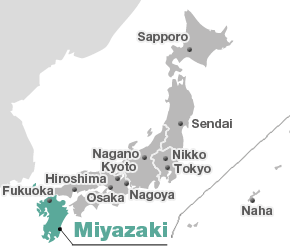
The areas of Miyazaki Prefecture.
I am in Miyazaki, Miyazaki.
Tokyo, and Tokyo Orientation had been busy and bustling. There had been hundreds of other JETs in the huge Keio Plaza Hotel and Tokyo city itself was big, bright, and fast-paced. Now it was just a few of us in a tiny rural city airport and everything seemed so small, quiet, and slow-paced by comparison. It was good. I felt like I could breathe out and relax a bit after days of flashiness and over-stimulation. For a place to settle and live in, this was more my style.

After lunch we were introduced to our supervisors and then taken to our respective areas within the prefecture. It was only midday on a Wednesday, but I was exhausted. All I wanted at this point was to be taken to my apartment, get out of my ridiculous monkey suit, have a cold shower, and then fall asleep... ANYWHERE!

Miyazaki Airport

However, being a working day in Japan, I was taken to my school, Omiya High School, to meet my Principal and the staff and see where all the magic of my new JET assistant language teaching job would happen.

What a welcome I got! As the car pulled up in front of the school, the boys' baseball team was standing at the entrance each holding a large coloured hiragana or katakana letter so that the message spelled out,
"サマンサ,おおみやへようこそ!” (Welcome to Omiya SA-MA-N-SA!).

Omiya High School, Miyazaki City
I was so touched! But I didn't really know what to do! I did the best I knew how and so got out of the car and walked around them smiling and saying any broken Japanglish I could while clapping and posing with them doing the typical Japanese peace sign photo pose while a student took photos (they really went crazy when I did that!). I felt like an awkward circus penguin, but it seemed to be having the desired effect of showing my gratitude.
The 1st Year Teachers' Office

I had realized before I left Canada that one of the most difficult things for me at first would be the awkwardness I would feel. Awkwardness because of misinterpreting a cultural action or not knowing the correct reaction. Awkwardness because I didn't have the language abilities to understand everything around me or express myself as I was used to. Awkwardness because of feeling a bit alone even though you are in a room full of people, but starting a conversation seems difficult. I knew these would be my issues. However, I had survived my first potentially awkward experience at my new school and hadn't seemed to offend anyone! I was off to a good start.

A Japanese style tea set
Next I was shuffled into the Principal's office to have tea. The Principal poured and gave me a delicate Japanese porcelain tea mug full of hot green tea. I didn't know if I should sit or stand or how or when to drink, and more importantly what to do or say. I wish I could have known I was going to be coming here so soon so that I could have prepared more to say. But then the baseball student who had taken some photos outside was translating for me and the Principal and I had a brief conversation (of which I remember absolutely nothing that was said). I'd say that I probably didn't score as highly on that next experience, but it seemed okay.

The Miyazaki City Hall... where many errands occurred
My supervisor then showed me to my desk area and, trying hard to think ahead and make good impressions, I asked her for the name of the student who was taking photos and helping to translate for me so that I could thank him later. "Student?", she said surprisingly and laughed, saying, "He looks young and everyone thinks so, but actually he is one of the new English teachers you will be working and teaching with; one of your JTEs". I was so embarrassed, but no matter how much I begged, she maintained that he and everyone else would find it amusing to know what I had thought. I groaned on the inside and I knew that my first of many awkward moments had happened.

The main street: Tachibana Dori
The rest of that first day was the beginning of the marathon of errands that every new JET has to go through in their first few weeks of arrival (and which I believe support a large part of the Japanese economy).

Miyazaki Prefecture's Dogs (Mascots).
One is a hyuganatsu fruit, one a beach
or palm tree themed, and the last a chicken.
The first errands involve getting your inkan (印鑑; official name stamp for all official documents), and having it registered, getting your residence card, health insurance card, apartment keys, getting the utilities turned back on in your apartment (and perhaps, if you have a very old one like mine, having the utilities man show you at least three times how to turn on the hot water for a shower with a strange maneuver of holding down a knob while cranking another until the flame ignites), and much more. It was a lot of running around to various places throughout the city, a lot of waiting in different rooms, and a lot of paperwork I did not understand or care about because I was just too tired. Yet to come was still the ordeal of getting a cell phone or internet, but those adventures were luckily saved for another day - I just might have died had they not been.
Further up in the more central area on Tachibana Dori

So the day was finally drawing to a close and some of my teachers took myself and another new JET out for dinner and then to get some groceries. I had met the other JET at Tokyo Orientation and she was from from Oregon, USA, and as it turned out would be living in the building across from mine. Little did I know then that she would become one of my best friends here in Japan, but at the time it was just comforting to have a familiar face with eyes as tired as mine smiling across the table.

In my next post;
Getting to Know Miyazaki

Wednesday, 6 August 2014

On Being Left Behind

I know I said that my next post would be about arriving at my new home, Miyazaki, however; I believe that you have to write what you feel, and today I miss my friends that have left me behind.
(今日、寂しくて悲しい。友達は帰っただから。。。)

The second time around is not easier in this case. Most JETs stay an average of two years, so going into my third year I have just experienced the great exodus of my incoming year's group. And as you can imagine, there's a special bond between those who navigate their first few months here together as illiterate, culturally unaware babies. Mistakes are made. Laughs are shared. We learn and adapt together to life in Japan.


Our phrase for making such a cultural error because of our inexperience or lack of awareness is "gaijin smash!!"  Gaijin / gaikokujin (外人・外国人)means foreign person and as such, sometimes we do come along and hulk our way through some delicate Japanese cultural practice.

An especially funny one I heard about recently was when a girl used a British colloquial phrase to cheers her co-workers at her goodbye party, and only found out after saying it a dozen times that in Japanese the word refers to a certain male appendage. Oops. My worst language mix-up (that I am aware of) is because in Japanese the words for fruit and children are similar, and so I once told my Japanese teacher that I had children for breakfast that morning...


Anyway, back to the goodbyes. While no names will be mentioned in my blog, I can't avoid all details and especially wish to share pictures, as these show it better. I'm sure those whom they concern won't mind. Please let me know if otherwise.


It's impossible to fully explain what my experiences in this wonderful community here have been like, but the pictures definitely give glimpses. So many laughs. So many smiles. So many special memories with amazing people.

I know beyond a doubt that some of the best people I have ever met were here with me in Miyazaki. 

So this post is a dedication post to all those wonderful people from various corners of the world that I was sad to see go, now or one year ago. You are missed.

Thank you because you have helped to make my Japan experience so incredible. And of course you have given me the best excuse for future travels! I hope to see you all again one day, with many great stories to tell.

I'm usually the one leaving others, so I suppose this is a good exercise in empathy. This doesn't make it easier though. But as one of my best friends always says, "Don't be sad that it's over, be glad that it happened". I certainly am.

Tuesday, 5 August 2014

2 Years Today in Japan

So today is my 2 year anniversary of arriving in Japan! In light of my anniversary (and more I will explain), I'm making a Japan blogging mission statement;

Saying goodbye at YVR
"This blog will be to share what my daily life in Miyazaki, Japan is like. Posts will be about my experiences from now, especially as they are compared with my reflections of the past 2 years". 


Vancouver JET friends about to start
their journey together!
So onto the more I said I would explain... I know that this is my last year in Japan. From now the clock is ticking. My time is slowly drawing to a close and Vancouver is pulling me home. I'm so happy to know this early so that I can go into every experience with it in mind and cherish all the "last times" that will be coming my way. This may sound overly dramatic to those that don't know me - well I'm a pretty sentimental person and I like this about myself! The other aspect too (it's not all me being gushy) is Japan's affinity for seasonal changes and incredible annual festivals. You'll see what I mean if you continue to follow my blog over the next year. I hope you do.
Day 1 of ESID Training
Let's explore Tokyo!
So where was I two years ago? Days were spent sweating in a suit listening to presentations at the JET Welcome Conference, where I learned that "every situation is different" and collected a lot of papers I haven't looked at since! But I think the most valuable thing about the conference is the chance to meet others, make connections, and know that you are not alone even though you are far from home.

Nights were spent out exploring the big, bright, bustling city of Tokyo with my Vancouver JET friends. I was hot, tired, and jet-lagged with a little bit of deer-in-headlights syndrome, but mostly my energy was high and I was excited to finally be starting the Japan adventure! Everything was new and incredibly exciting!

At first I was so surprised by
the characters everywhere,
and now it seems so normal!
I remember my first impressions of Tokyo. I couldn't understand anything; it was all in "hieroglyphics", as my father aptly said during my parents' visit last spring. There were vending machines around every corner, sometimes rows and rows of them. I was overwhelmed by the many neon signs jumping out at me from every direction, but especially high above me. The city seemed to go endlessly upwards, and exploring these buildings I found that there was a completely new world on every floor and through every door.

Neon lights just going up, up, up!
While I knew to expect it, I was also surprised by how prevalent the anime culture was. And while I didn't come to Japan seeking it out or excited for it, it's definitely been interesting to see this unique side of Japan.
A brightly painted elevator taking us between "worlds" in Tokyo.

Taking a train even just one stop over was a confusing and crowded ordeal, in which I was relieved to have others with me who seemed to know how to get a ticket and where to go, because the map looked more like a colourful spider's web to me. I'm glad that I could be as capable when exploring Tokyo with my parents a year and a half later! Human adaptability is an amazing thing.

In my next post;
Exploring my New Home - Miyazaki!